Orlando attics serve as active heat sinks where summer air temperatures frequently exceed 130 degrees Fahrenheit, accelerating the decomposition of pest bio-matter and concentrating airborne allergens directly above…
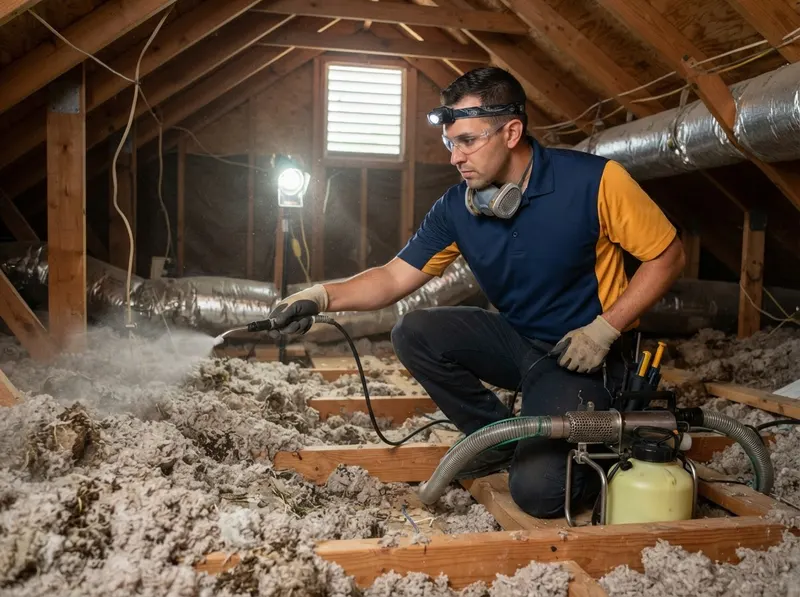
Orlando attics serve as active heat sinks where summer air temperatures frequently exceed 130 degrees Fahrenheit, accelerating the decomposition of pest bio-matter and concentrating airborne allergens directly above ceiling drywall. Rodents, squirrels, and silverfish nesting across residential neighborhoods like Baldwin Park, College Park, and Lake Nona deposit urine, feces, and ectoparasites that seep through untreated loose cellulose or fiberglass rolls. If organic waste remains inside the thermal envelope, pheromone trails continue to trigger re-infestations even after perimeter barriers are laid down. Attic insulation pest sanitization resolves this biological hazard by lifting fouled layers, running high-efficiency particulate air filtration to clear spore concentrations, and misting structural wood trusses with virucidal disinfectants.
Selecting a localized spot sanitization versus a complete insulation extraction hinges on the distribution of nesting zones and ductwork contamination. When pest traffic is limited to a single soffit junction over a garage in MetroWest or Dr. Phillips, target sanitization treats the specific 100-to-200-square-foot footprint while leaving untouched thermal boundaries intact. Conversely, broad roof-rat activity across older bungalow ceilings in Thornton Park or Delaney Park requires an entire vac-out; leaving rodent-saturated insulation in place creates a trade-off where minor cost savings yield chronic indoor air contamination and degraded R-values. Blown boric-acid treated cellulose replaces old material to impart mechanical pest resistance and restore cooling efficiency across Orlando's extended cooling seasons.
Work follows a three-stage mechanical containment process. First, technicians establish negative air pressure with sealed plastic sheeting across access hatches to prevent airborne droppings or chemical mists from entering family living areas. Second, high-powered vacuum lines routed out through eaves extract contaminated insulation directly into exterior containment filtration bags, preventing particulate dispersal into suburban yards in Hunter's Creek or Rosemont. Third, exposed ceiling joists and junction penetrations receive direct structural sanitization, followed by mechanical exclusion using hardware mesh and expanding polyurethane foam to lock ingress pathways against future subterranean or roof-level invaders.
Every job gets a firm, written price after a free on-site visit.
Tell us about your attic insulation pest sanitization job in Orlando and we'll send a clear, written quote, usually the same day.
 BugVault Pest Control