Bed bug infestations in Orange County accelerate rapidly due to continuous indoor climate-control cycles that keep homes between 70°F and 78°F year-round. While retail contact sprays scatter bed bugs further into…
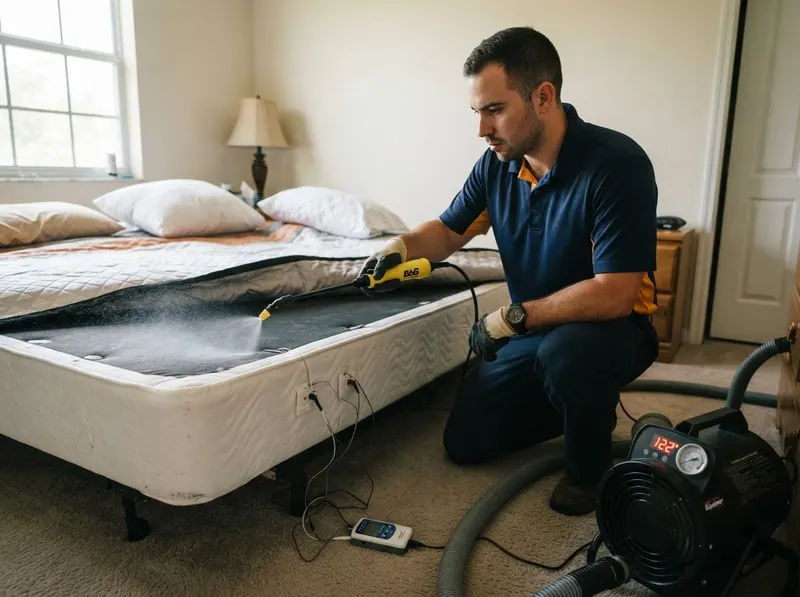
Bed bug infestations in Orange County accelerate rapidly due to continuous indoor climate-control cycles that keep homes between 70°F and 78°F year-round. While retail contact sprays scatter bed bugs further into electrical wall outlets and drywall voids, integrated remediation pairs structural heating units with long-chain chemical residuals. High-temperature convective airflow heats interior harborages to lethal thermal death points between 120°F and 135°F, penetrating deep into mattress cores, baseboard crevices, and wall framing where chemical mists cannot reach. Once the heat cycle eliminates active adults, nymphs, and desiccation-resistant eggs, technicians apply non-repellent insect growth regulators to concrete perimeters and subfloors to prevent re-infestation from lingering hitchhikers.
Property construction across Orlando dictates specific tactical adaptations during the remediation process. In historic wood-framed homes in Thornton Park and College Park, airflow must be continuously re-balanced with thermal monitoring probes to account for uninsulated wall cavities and raised crawl spaces that vent ambient heat. Conversely, modern multi-story slab builds in Lake Nona and Baldwin Park require sustained internal air pressurization to drive lethal temperatures past high-density insulation and laminate underlayments. For properties located in humid microclimates near Lake Eola Park or along the tree canopies of Leu Gardens, ambient relative humidity elevates bed bug resilience, demanding extended soak times at peak temperature to denature target proteins fully without causing structural warping to interior trim.
Choosing between standalone chemical remediation and integrated thermal-chemical remediation depends on furniture density and containment severity. Standalone chemical protocol requires 2 to 3 separate applications spaced 14 days apart to intercept newly hatched nymphs, presenting an operational trade-off of extended occupant disruption. Integrated thermal treatment achieves absolute biological knockdown in a single 8-hour window, backed by residual spot applications along structural baseboards. Occupants remove heat-sensitive items, including aerosol cans, wax candles, prescription medications, and oil paintings, prior to unit deployment, leaving structural drywall, upholstery, and bed frames fully staged for complete thermal penetration.
Every job gets a firm, written price after a free on-site visit.
Tell us about your bed bug heat and chemical remediation job in Orlando and we'll send a clear, written quote, usually the same day.
 BugVault Pest Control