Orlando rodent exclusion and trapping targets the biology and climbing behavior of Rattus rattus, the invasive roof rat that populates Central Florida's live oak and citrus canopies. In suburban communities like…
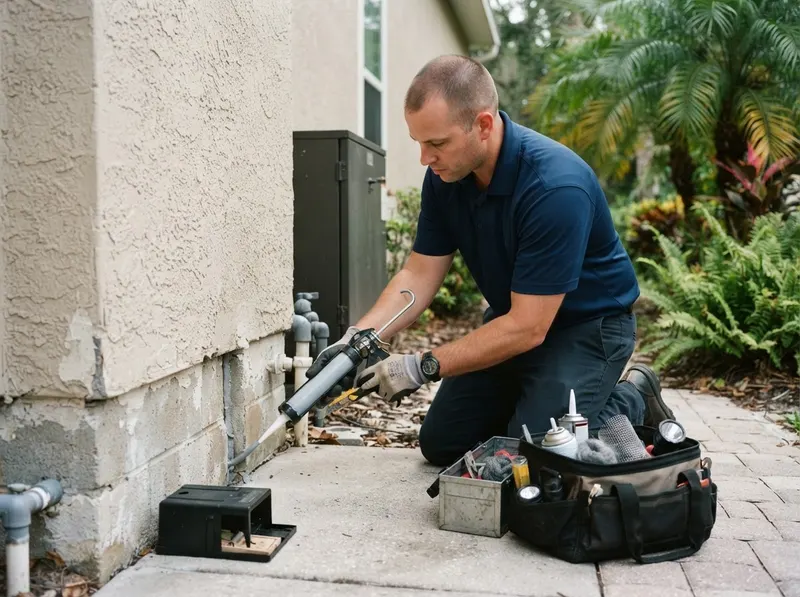
Orlando rodent exclusion and trapping targets the biology and climbing behavior of Rattus rattus, the invasive roof rat that populates Central Florida's live oak and citrus canopies. In suburban communities like Baldwin Park, College Park, and Lake Nona, roof rats bypass ground-level treatments entirely by traveling along utility lines and tree limbs directly onto tile roofs and asphalt shingles. Once on the structure, rodents exploit construction gaps along fascia boards, soffit vents, and plumbing stacks to enter attic insulation. Attics in Orange County routinely exceed 120 degrees Fahrenheit during summer afternoons, driving rodents downward into wall voids and air-conditioning chases where they chew electrical wiring and contaminate blown fiberglass with urine and droppings. Mechanical exclusion resolves this by installing 19-gauge hot-dipped galvanized hardware cloth and metal flashing over every void larger than 0.25 inches, the exact diameter required for a juvenile mouse or adult roof rat skull to pass.
A complete physical exclusion differs fundamentally from recurring bait boxes. Exterior bait stations deploy anticoagulant rodenticides that leave poisoned animals to expire inside wall voids, producing odor hazards and secondary poisoning risks for neighborhood pets and predatory birds around Lake Eola Park and Leu Gardens. Trapping inside the containment zone relies exclusively on professional mechanical snap traps secured along identified structural run lines, attic purlins, and ledger boards. Traps are monitored and cleared directly, ensuring carcass extraction and preventing the dispersion of secondary pests like bat bugs and mites into ductwork. If a home has active attic noises and droppings, a total exclusion paired with targeted internal trapping eliminates the population and seals the envelope; if an open warehouse or outbuilding lacks physical doors, trapping and exterior containment barriers serve as the operational limit.
Properties in established, tree-dense neighborhoods such as Audubon Park, Thornton Park, and Delaney Park frequently present hidden structural transitions where barrel tile roofs interface with flat decking. These intersections allow rodent ingress directly into vaulted ceilings. In planned unit developments such as MetroWest, Dr. Phillips, and Hunter's Creek, barrel tile roofs utilize foam or mortar closures that degrade under severe summer rainstorms, creating unmonitored entryways for roof rats seeking conditioned ceiling drywall. Modern building codes require roof ventilation, but standard plastic ridge caps and off-ridge louvered vents are easily gnawed open by rodent incisors, which possess a Mohs hardness rating of 5.5. Fortifying these exhaust zones with heavy-gauge expanded steel screens prevents reentry without restricting necessary attic airflow or triggering indoor moisture retention.
Structural protection follows four deliberate stages to ensure biological containment: 1. A complete 360-degree roofline, soffit, crawlspace, and crawl hatch inspection maps all active trails, rub marks, and gnaw sites. 2. All exterior apertures, pipe penetrations, and roof-wall junctions are sealed using chew-proof metallic flashing, structural fasteners, and architectural sealants. 3. Interior mechanical traps are calibrated and positioned along structural runway paths inside the attic envelope. 4. Resetting, sanitizing, and removing trapped rodents proceeds at scheduled 48-hour intervals until three consecutive checks yield zero captures, confirming structural clearance.
Every job gets a firm, written price after a free on-site visit.
Tell us about your rodent exclusion and trapping job in Orlando and we'll send a clear, written quote, usually the same day.
 BugVault Pest Control