BugVault Pest ControlBugVault Pest Control

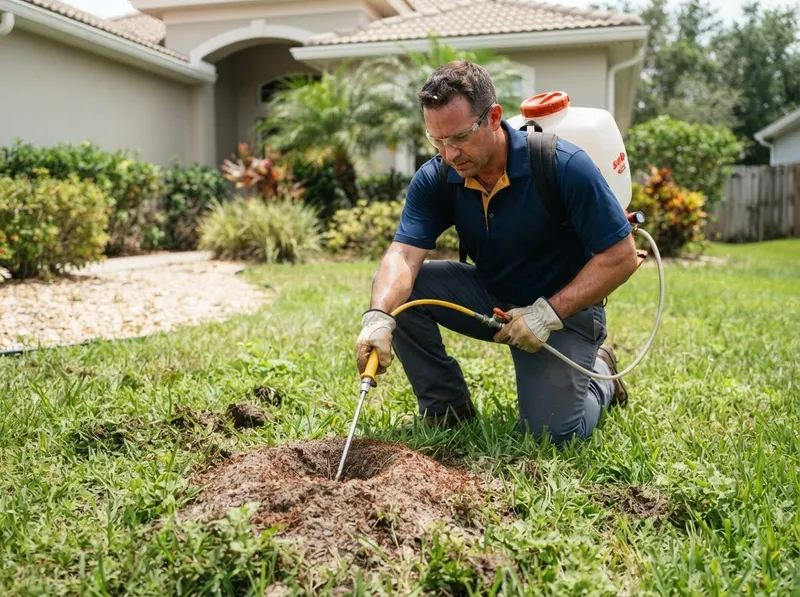
Fire Ant Mound Injection and Turf Treatment Orlando

Orlando soil profiles, characterized by excessively drained Candler and Tavares sands in elevated ridges like College Park and Dr. Phillips, allow Solenopsis invicta workers to excavate vertical shafts exceeding 4 feet…
Get My Free Estimate →(407) 751-3074
Fire Ant Mound Injection and Turf Treatment in Orlando, FL
Quick answer
  • Phase 1 pressurized injection directly into the mound core targeting subterranean queens; Phase 2 broadcast insect growth regulator (IGR) across all turfgrass zones.
  • Injection pressure of 25 to 30 PSI saturates soil shafts down to 36 inches within 15 minutes per mound; total site treatments average 60 to 90 minutes.
  • Services start at a strictly observed $250 minimum charge for suburban parcels up to 0.25 acres, with exact scope confirmed during a visual on-site evaluation.
  • Protocol eradicates imported red fire ants (Solenopsis invicta) from sod, root zones, paver boundaries, and irrigation control valve boxes.
  • Property scheduling is arranged via direct dispatch at (407) 751-3074, requiring verified property square footage and gated access clearance.

Orlando soil profiles, characterized by excessively drained Candler and Tavares sands in elevated ridges like College Park and Dr. Phillips, allow Solenopsis invicta workers to excavate vertical shafts exceeding 4 feet in depth. During intense summer downpours, colonies construct high external mounds to escape saturated subsoil, but the reproductive queens retreat into protected subterranean chambers beneath root zones. Surface dusts and topical pyrethroid granules fail because contact toxicity triggers emergency dispersal, causing the queen to relocate deeper or fracture the colony into multiple satellite mounds. Pressurized injection bypasses surface crusts by delivering non-repellent actives at 25 to 30 PSI directly into vertical tunnels, achieving complete biological saturation before workers can mount defensive relocation tactics.

A single mound drench is insufficient for full lawn protection; effective control pairs direct injection with a granular insect growth regulator broadcast across all surrounding turf. In developments such as Lake Nona, Baldwin Park, and Hunter's Creek, where St. Augustine and Zoysia sod maintain high moisture levels via reclaimed irrigation, foraging worker paths extend up to 100 feet from the nest entrance. Insect growth regulators disrupt the synthesis of chitin, sterilizing the queen and preventing pupae from maturing into stinging workers over an 8 to 12-week life cycle. The trade-off is mechanical speed versus persistent biological clearance: direct mound injection neutralizes biting field units within 24 to 48 hours, while broadcast regulators secure the perimeter against reinvasion from neighboring parcels or retention pond easements.

Treatment zones require clear operational access and dry weather windows. Applications in sandy Orange County yards cannot proceed under active standing water or immediate tropical storm deluges, as hydraulic runoff displaces granular regulators before binding can occur within the soil profile. Liquid injection remains stable below the thatch layer, creating an insoluble chemical barrier that adheres to soil aggregates. Technicians map subsurface utilities around irrigation valves, decorative landscaping, and patio footings before mechanical probe insertion to safeguard property infrastructure.

Fire Ant Mound Injection and Turf Treatment cost in Orlando

Suburban Lot Under 0.25 Acre (Up to 5 Mounds + Full Turf Treatment)$250 to $350
Standard Residential Lot 0.26 to 0.5 Acre (Up to 10 Mounds + Broadcast IGR)$350 to $475
Estate Property 0.51 to 1.0 Acre (Extensive Mound Injections + Full Turf)$475 to $725
Acreage Properties Over 1.0 Acre (Per Acre Injection & Broadcast Protocol)$250 per acre addition after baseline

Every job gets a firm, written price after a free on-site visit.

Common questions

How does fire ant mound injection differ from surface lawn treatments in Orlando?
Direct mound injection drives liquid fipronil 18 to 36 inches into subterranean nesting chambers using steel root probes at 25 PSI to eliminate the egg-laying queen, whereas standard surface treatments only reach foraging workers crawling in the upper grass blades.
Why do fire ants in Orlando quickly return after hardware store bait applications?
Store-bought hydramethylnon or spinosad baits degrade rapidly under Orlando ultraviolet light and lose biological efficacy within 48 hours, often prompting colonies to separate into multiple satellite nests rather than eradicating the subterranean queens.
Is the turf treatment safe for dogs and children in Orlando yards?
Lawns are fully accessible once the liquid injection has settled into the subsoil and the broadcast granular treatment has dried completely, typically requiring a drying window of 2 to 4 hours under Central Florida sun.
What is the minimum charge for fire ant eradication in Orlando?
The structural baseline service carries a minimum charge of $250, which covers full yard inspection, pressurized core injection for up to 5 active mounds, and broadcast growth regulator distribution across lots up to 0.25 acres.
How soon will mounds show complete inactivity in Orlando soils?
Colonies display a cessation of surface defense within 4 to 12 hours after mechanical injection, with total colony mortality occurring within 24 to 72 hours as the non-repellent chemistry is passed between workers and the brood.
Helpful resources

Trusted references & local links

USA.gov, government & consumer helpBetter Business BureauFTC Consumer AdviceU.S. Small Business AdministrationReady.govU.S. EPAENERGY STARU.S. Dept. of EnergyConsumer.govU.S. Census BureauGoogle Maps, Orlando, FL

Get started today

Tell us about your fire ant mound injection and turf treatment job in Orlando and we'll send a clear, written quote, usually the same day.

Get your free Pest Control Service quote, Orlando

We only use your ZIP to check availability, no spam.